
Few educational institutions in Spain can tell their story through the technology they have used to teach. The Centre for Culture and Knowledge (CCC) can: it began in 1939 with language courses using records, went on to incorporate video and the first computer systems, and today trains more than 4,000 students on official vocational training courses and a further 1,000 on technical specialisation courses every year.
Translated with DeepL.com (free version)
This overview clearly illustrates the current challenge. An ever-expanding range of courses, two delivery methods – face-to-face and online – very different student profiles, and the need for all of this to coexist within a single digital environment.
The challenge: a growing range of products and a business environment that needed to grow alongside it
The growth of online learning forced CCC to rethink its platform. Simply hosting content was not enough: an environment capable of supporting a much more diverse learning experience was needed.
The requirements were clear from the outset:
- Manage different programmes, profiles and methodologies within a single platform.
- To facilitate access to content and activities.
- Monitor each student’s progress and assessment.
- To improve communication between students and teaching staff.
- Integrate with other systems and processes within the organisation.
And there was one fundamental condition that carried just as much weight as the others: the platform could not become a ceiling. For an institution with a history stretching back more than eight decades, the solution had to be able to evolve alongside it, without being tied to a closed system.
The decision: why Moodle?
CCC put forward four criteria: flexibility, scalability, customisation and integration, and Moodle met them all.
‘We chose Moodle because its open and modular architecture allows us to adapt the platform to our educational model, incorporate new features and integrations, and progressively develop our students’ digital experience.’ – Marta Gómez, CCC
Added to this were the project’s maturity, its international community and something that CCC particularly values: a technological ecosystem that does not limit its capacity for innovation.
The solution: a Moodle ecosystem supported every step of the way
At 3ipunt, we provide CCC with comprehensive support in the development of its Moodle ecosystem: hosting, support, consultancy, customisation, development and integrations.
1. Hosting managed by Moodle specialists
Having the infrastructure and platform managed by a team that understands the ins and outs of Moodle means we can anticipate problems rather than react to them. As the CCC team puts it, it is, above all, a matter of peace of mind.
2. A clearer visual experience with Fresk
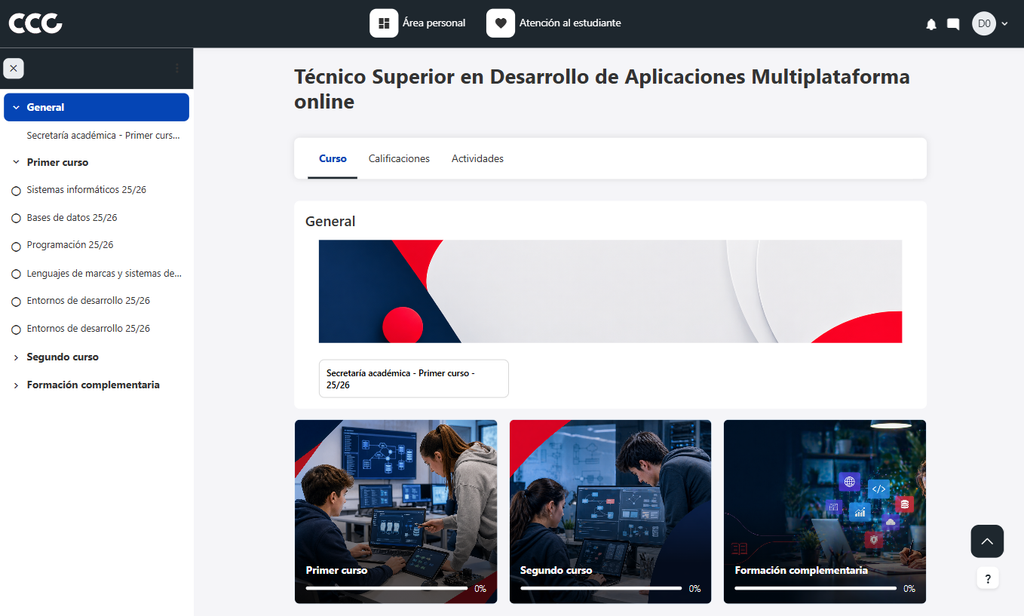
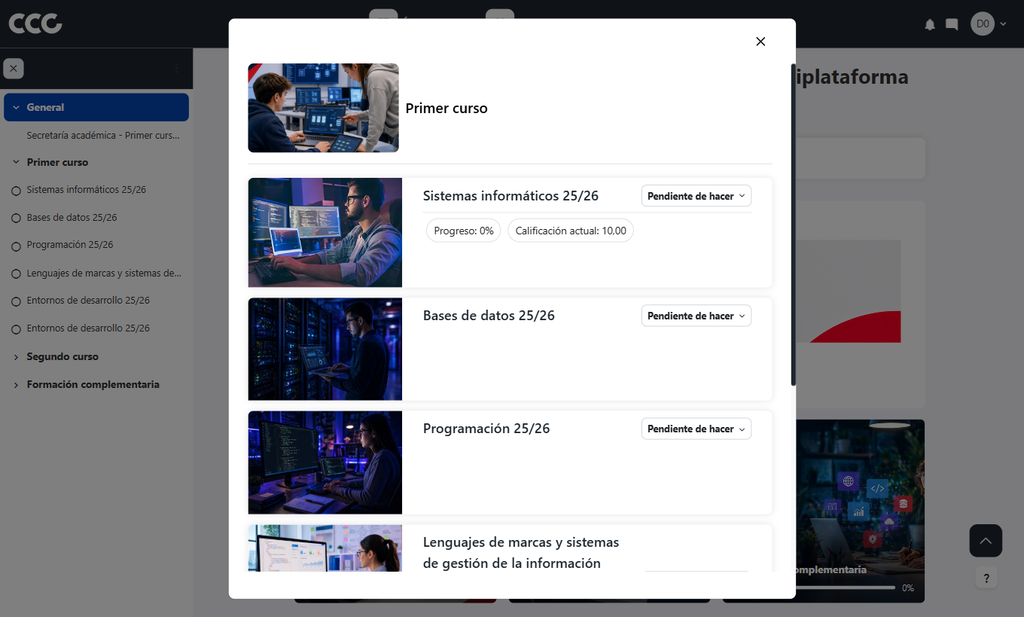
CCC customised its Moodle platform with the < 3 >Fresk theme and a course layout designed to simplify navigation. The result: content presented in a clean, modern and intuitive way, with less complexity for students and a greater focus on learning.
3. Plugins for FUNDAE and SEPE
The ecosystem includes specific reports for < 3 >FUNDAE, which facilitate the management of the information required for subsidised training, and a plugin for integration with the SEPE that connects Moodle with the processes required by the organisation.
4. A migration completed in record time
One of the most notable aspects of the project was the migration of content from the previous platform. Rather than moving the material course by course, much of the process was automated.
‘The ability to find a solution to automate a large part of the process meant that our team did not have to transfer the content manually – a task that would have required a very significant investment of time and resources.’ – Marta Gómez, CCC
The platform migration was carried out much more efficiently and with minimal disruption to internal teams.
Results: from a shared environment to proactive monitoring
The first change was to have a single digital environment from which to organise and manage the entire learning experience. The second, and more interesting, change came later: using the platform’s data to provide better support for students.
CCC has developed dashboards and monitoring alerts that enable it to identify at an early stage those who are falling behind and take action before they drop out. All of this is managed from its new experience centre, with a very specific aim: to increase the completion rate.
Among the features with the greatest impact, the team highlights:
- Content management and organisation.
- Online activities and assessments.
- Monitoring completion and progress.
- Grading systems and report generation.
- The possibilities for integration and customisation.
For internal teams, the key factor has been the ability to automate processes and obtain real-time information on student activity. For students, it has been the availability of a centralised environment accessible from any device, which gives them the autonomy to manage their own learning.
Looking to the future
CCC envisages a learning experience that is increasingly flexible, personalised and aligned with the real needs of the labour market. Artificial intelligence, automation and data analysis will play an ever-greater role: better resources, early identification of difficulties and more personalised support. With one important caveat: technology must reinforce the role of teachers and professionals, not replace it.
‘After more than 85 years dedicated to training, one thing has remained constant for us: technology and methodologies change, but the aim remains the same – to help people progress and shape their future through learning.’ – Marta Gómez, CCC