
The Sitges Carnival, the Festa Major and the Barracas attract thousands of people every year. Behind the scenes, there are organisations that run and manage these events, and it is becoming increasingly important for them to know how to respond to incidents of sexual assault or LGBTI-phobic behaviour.
The Sitges Town Council’s Civil Rights Service had a Protocol for Tackling Sexual and LGBTI-phobic Violence in public festival spaces; what it needed was a way to get this information across to the people involved in these organisations and also to members of the public who were interested. The solution was an online course set up using Moodle Studio (formerly Goodle),3ipunt’s turnkey training platform, which anyone can take at their convenience and on whatever device they have to hand. This is, essentially, what online training for public administrations is for:making content accessible to people who cannot fit it into their schedules.
A municipal service facing challenges on many fronts
The Sitges Town Council’s Civil Rights Service is made up of seven staff members and supports a wide range of groups within the municipality:
- Women’s Support Service (SIAD) and support in cases of gender-based violence.
- Comprehensive LGBTI support service and support for victims of LGBTI-phobic violence.
- Inclusion and support service for people with disabilities.
- A support service for migrants and new arrivals in the municipality. These are very different areas, but they share a common aim: the wellbeing of the community.
The challenge: ensuring the protocol reaches those who organise the parties
The Protocol for Tackling Sexual and LGBTI-phobic Violence in Public Festival Settings is a municipal document, and its effectiveness depends entirely on it being known to the organisations responsible for each event and to as many members of the public as possible.
“We were looking for an easy and flexible way to raise awareness of the protocol through a course that could be taken at any time.” (Anna Serra – Department of Social Rights, Citizenship and Equality).
The usual approach (face-to-face training) requires participants to be available on a specific day at a specific time. Yet what the service was aiming for was precisely the opposite: to make it easier to reach people who do not normally have time to attend face-to-face courses. This is exactly the gap that online training for public administrations fills: it is not a question of technology, but of availability.
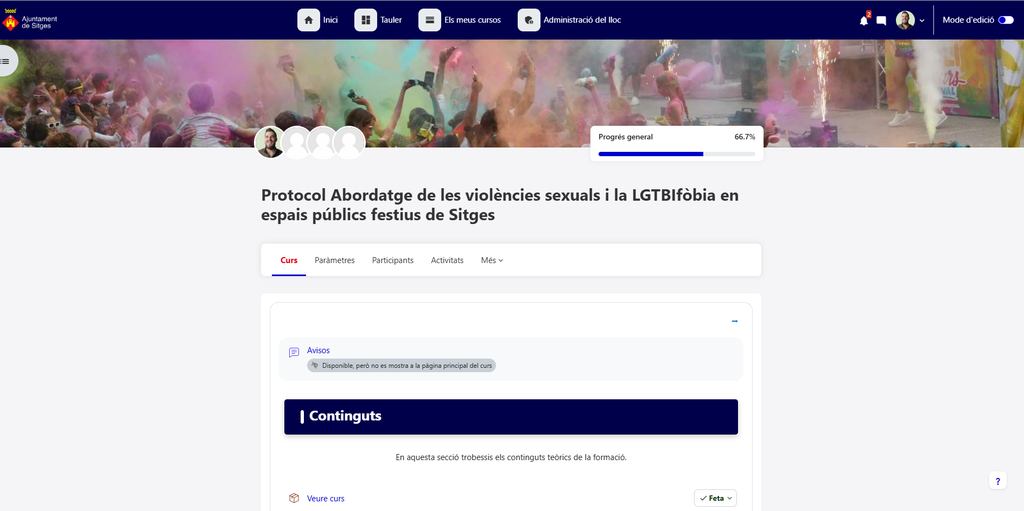
The solution: an asynchronous course hosted on Moodle
The Civil Rights Service came to 3ipunt on the recommendation of others and opted for Moodle Studio, 3ipunt’s Moodle-based online training solution. It is a ready-to-use platform, requiring no bespoke development or in-house infrastructure to maintain, designed specifically for organisations that need to start delivering training without first setting up an IT department.
- Asynchronous course. Each person joins when they can, not when it’s their turn.
- Access via mobile. No need to install anything, and no need to have a computer to hand.
- Training open to external organisations. The course is not intended for municipal staff, but for organisations within the municipality.
- Managed by the service itself. The team maintains and updates the course without relying on third parties.
The learning curve: from ‘this is a right nightmare’ to managing it on our own
It’s worth saying it as it is: it didn’t get off the ground straight away. Setting up a course from scratch on a new platform, within a team that isn’t specialised in technology, involves a real initial cost.
“The process is cumbersome at first, but as you learn, the learning curve becomes less steep.” (Anna Serra – Department for Social Rights, Citizenship and Equality).
In any case, it is the result that matters: today, the Civil Rights Service manages its own affairs independently.
What’s working best
For the time being, the course has been taken up by people involved in the Festa Major and the Sitges International Fantastic Film Festival. And what the team highlights as most useful is not any advanced feature:
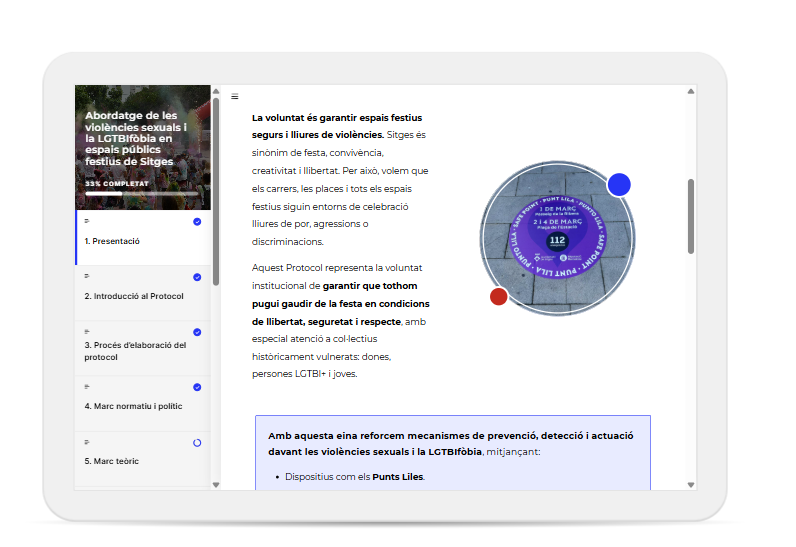
- Being able to take the course asynchronously. This is what opens the door to people who were previously excluded.
- Being able to do it on a mobile phone. A mobile phone is the device most volunteers and organisers actually use.
“We are reaching people we hadn’t been able to reach before.” (Anna Serra – Department for Social Rights, Citizenship and Equality).
The work that lies ahead: from having the course to ensuring everyone takes it
Having the training available is only half the battle. The other half is raising awareness, and in that regard the project is still in its infancy.
This is a familiar challenge in any voluntary and open training programme, and the calendar is on our side. The municipality’s upcoming festive events, starting with Carnival, provide the perfect opportunity for the organising bodies to take the course. The next step in the project is not a technical one: it involves raising awareness and tracking who completes the course.
Online training for public administrations
At 3ipunt, we work with local councils, provincial councils and public services that need to provide training for both their staff and the public. We are a Moodle Certified Partner and hold certification under the National Security Scheme (ENS), a standard requirement when a platform hosts data linked to public bodies.
And, as the case of Sitges shows, the support does not end once the platform is up and running: it continues whilst the team learns how to use it.