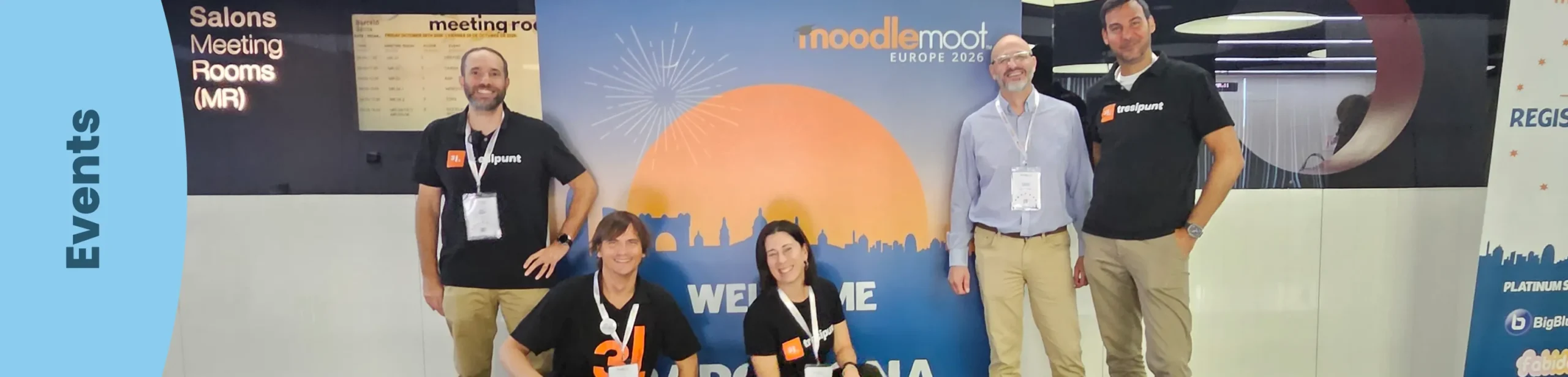
From 7 to 9 October, Barcelona brought together the European Moodle community for an event whose theme served as a statement of intent: ‘small enough to connect, big enough to matter’. Three days, three parallel tracks – education, technical, and business and HR – and a welcoming atmosphere that was already evident at the welcome coffee reception. We at 3ipunt were there with Meritxell Revés, Antoni Bertran, Josep María Aleu, Ebrahim Mesleh and Cristiano Zerbinati, and Antoni gave two talks.
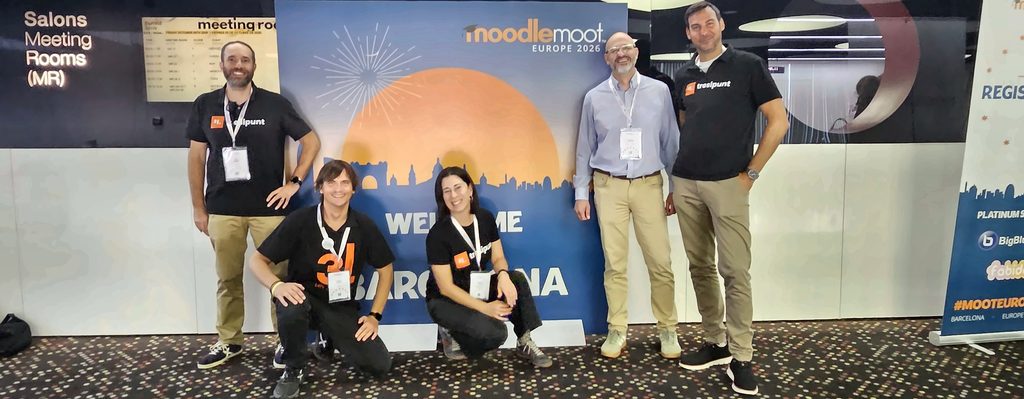
What did the Moodle community in Barcelona take away from the event?
One idea stood out above the rest: digital sovereignty ceased to be a background issue and became the central theme of the event. And not merely as a topic of discussion, but as a very specific question: who controls the platform, the data and the artificial intelligence models currently used by universities, public authorities and businesses? If your organisation uses Moodle, much of what was discussed in Barcelona relates to decisions you will have to make in the coming months.
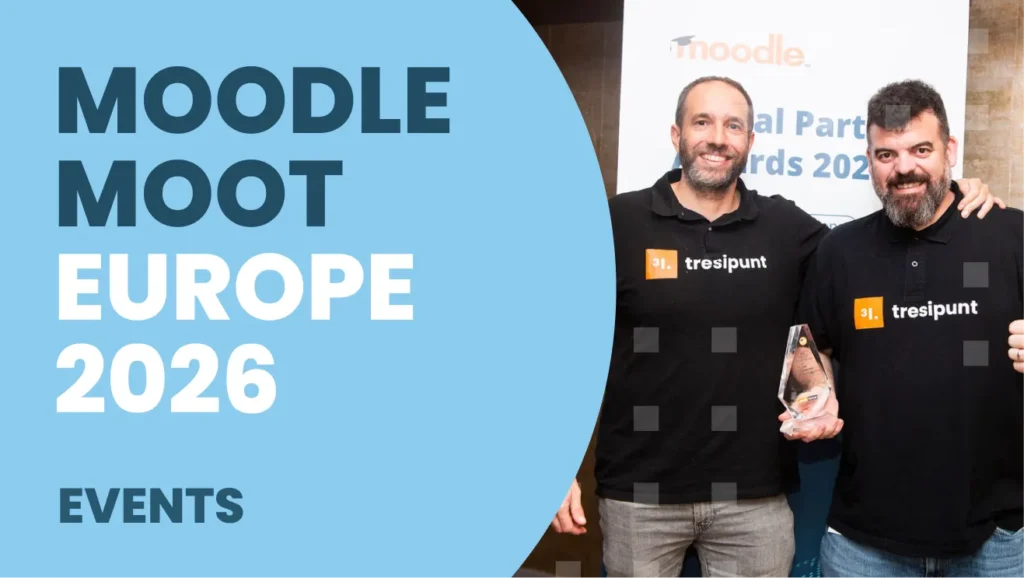
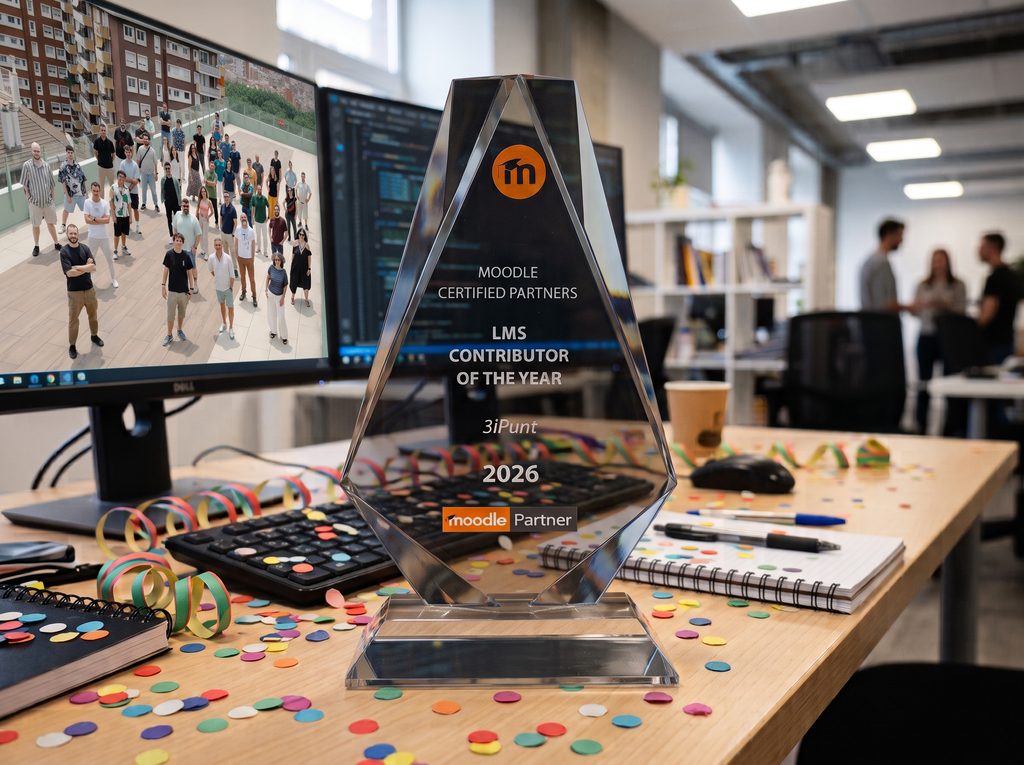
LMS Contributor of the Year 2026
At the Moodle Certified Partner Awards, held this year in Barcelona, Moodle recognised us as the partner that has made the greatest contribution to the Moodle LMS project. The award takes three factors into account: innovation, growth and our contribution to the community.
This is now the third year running that we’ve received recognition from Moodle, and this one holds particular significance, because it speaks precisely to what was discussed over the three days: open source is built by many hands. Thank you to Moodle and thank you to the whole community. Being at the heart of that project is what drives us every day.
The sessions that defined the three days
The main sessions set the tone for the three days:
- Martin Dougiamas, founder of Moodle, opened the event on Thursday with a talk entitled The Future of EdTech: where is educational technology heading when AI ceases to be a feature and becomes infrastructure?’
- In The Last Generation of Experts, or the First?, Anton Christodoulou posed an uncomfortable question: what does professional expertise mean in a context where machines respond faster than people?
- Scott Anderberg, CEO of Moodle, brought the event to a close on Friday with a talk entitled ‘Built for Sovereignty from the Beginning’, reminding the audience that open source is not a cheap alternative, but a decision about who is in control of your technology.
The event had kicked off on Wednesday with an afternoon of workshops, and one of the ones that interested us most was the one led by Laia Canet (Brickfield Education Labs), ‘Better by Design: Using Empathy to Remove Business Barriers and Create Opportunities’. The session turned the usual argument on its head: accessibility is often championed from the perspective of regulatory compliance, whereas here it was approached from the perspective of empathy and its impact on business. Using practical examples, she demonstrated how removing barriers drives innovation, improves the customer and employee experience, and leaves the organisation better prepared for what lies ahead. It is the same idea we champion when we talk about accessibility in Moodle: complying with the standard is the starting point, not the end goal.
The event brought together many of the key figures driving the ecosystem in Europe: Marie Achour, Fred Dixon, Gill Ferrell, Marc Alier, Philippe Petitqueux, Isaac Marco Blancas, Tiago Santos, Francesc Santanach, Quelic Berga and the team at Moodle HQ, amongst many others.
Your Data, Your Infrastructure: On-premises AI and open analytics
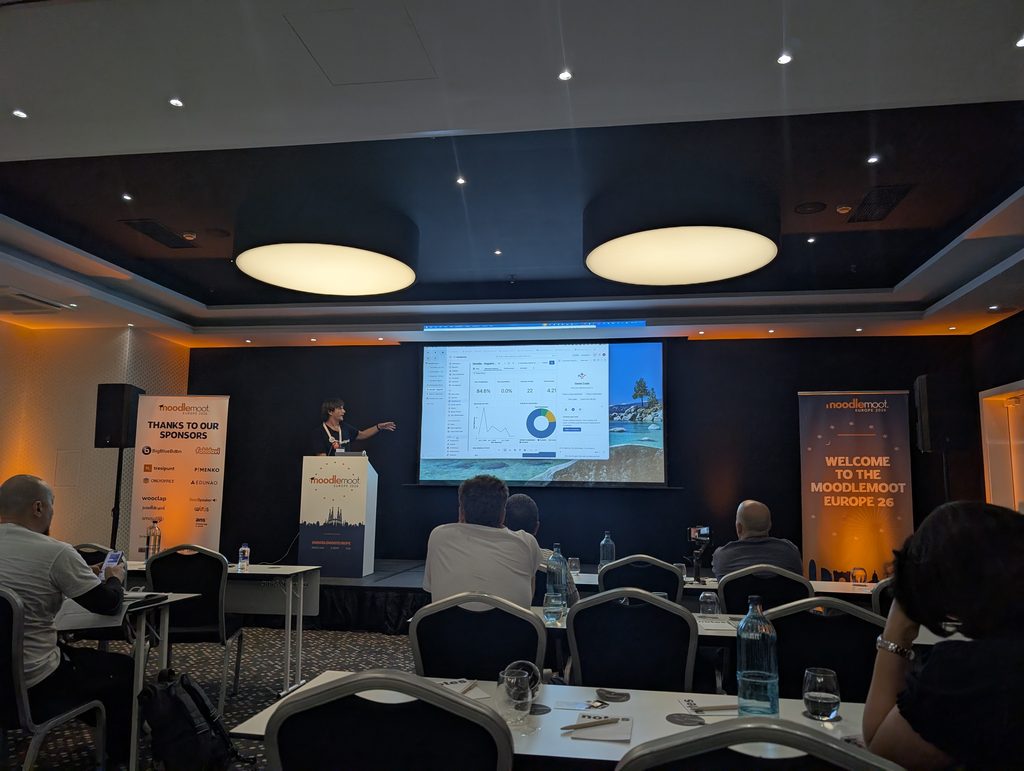
The first talk by Antoni Bertran, CTO of 3ipunt, on Thursday on the technical stage, got straight to the point. More and more organisations want to implement AI and learning analytics in their Moodle, and the quickest way to do this is almost always to send data to an external service.
The session presented an alternative: AI models run on your own infrastructure and open-source analytics tools, with student and staff data kept in-house. This approach requires more architectural work, but it avoids the fundamental problem facing any privacy policy: once data leaves the organisation, control is relinquished.
No Standards, No Sovereignty: standards as a precondition
Antoni’s second session, on Friday alongside Gill Ferrell (1EdTech Europe), brought together two discussions that are usually treated separately.
The thesis: without open interoperability standards, sovereignty is impossible. An institution may host its own platform yet remain tied to a single provider if its academic data, credentials or integrations are only compatible with a proprietary format. This is the line of work we have been pursuing at 1EdTech Europe, mapping specifications such as Edu-API and Open Badges against European frameworks, as we previously reported in our coverage of 1EdTech Learning Impact Europe 2026.
What we are building together
Beyond the talks, much of the event’s value lay in seeing European projects progressing simultaneously:
- The OpenEU alliance’s Joint Learning Platform, presented by Francesc Santanach (UOC), which faces the challenge of connecting institutions with very different cultures and levels of technological maturity.
- Personal spaces and the lifelong portfolio, with Quelic Berga’s proposal on who should be responsible for safeguarding each person’s learning history.
- Moodle LMS 5.3 and Moodle Workplace 5.3, presented by the Moodle HQ team, and the product roadmap with Marie Achour.
What we took away from MoodleMoot Europe
We go to these meetings with one question in mind: which aspects of all this are applicable to the projects we’re currently working on. Here’s what we’ve taken away from Barcelona:
- AI in the LMS is no longer discussed as a possibility, but as a decision. It’s not just a matter of ticking a box: you have to choose where the AI runs and who can view your pupils’ data. And that’s decided when the platform is set up, not once it’s already up and running.
- Open standards are the cornerstone on which everything else rests. Without them, technological independence lasts only as long as the contract with the supplier.
- The European path is being built through partnerships. Between public authorities, universities, partners and Moodle HQ, with a shared goal: to ensure that digital education grows without anyone losing control of their technology.
At 3ipunt, we have been working on e-learning projects for over 15 years and, as a Moodle Premium Partner, we are involved in the forums where these decisions are made. Being part of this process allows us to approach projects with the groundwork already done, rather than having to react when regulations become more stringent.