


Managing a virtual campus for thousands of students involves much more than simply having a learning platform. Integration with academic systems, scalability and the ability to respond to unforeseen circumstances are factors that make all the difference.
This is the case with San Jorge University, an institution that has been using Moodle for years and which, in partnership with 3ipunt, has developed its virtual campus into a fully integrated platform, ready to grow and adapt to the new challenges facing higher education.
A university with a clear commitment to innovation
San Jorge University (USJ) was founded in 2005 and is part of the San Valero Group. With around 7,000 students, its aim is to provide a well-rounded education that prepares students to meet the professional challenges of a constantly evolving society.
Despite its growth, the university maintains a culture strongly characterised by innovation, a close-knit atmosphere and continuous improvement. As Daniel Jiménez, head of the platform and of Teaching Innovation, explains:
‘We are a young university and we have had to learn quickly. This has left its mark on the organisation’s culture, reminding us of the need for daily learning and constant adaptation.’
The challenge: a more integrated, scalable Moodle that is ready for growth
San Jorge University has always used Moodle, but the institution’s growth meant it was necessary to take things a step further.
The main objective was to have an environment capable of integrating fully with their corporate systems in order to automate processes that, until then, had represented a significant workload.
The main needs included:
- Automate the synchronisation of users, courses and enrolments.
- Integrate Moodle with the academic management system.
- Improve performance during peak access times.
- To have access to local, specialist support.
- To have a flexible platform that could evolve alongside the university.
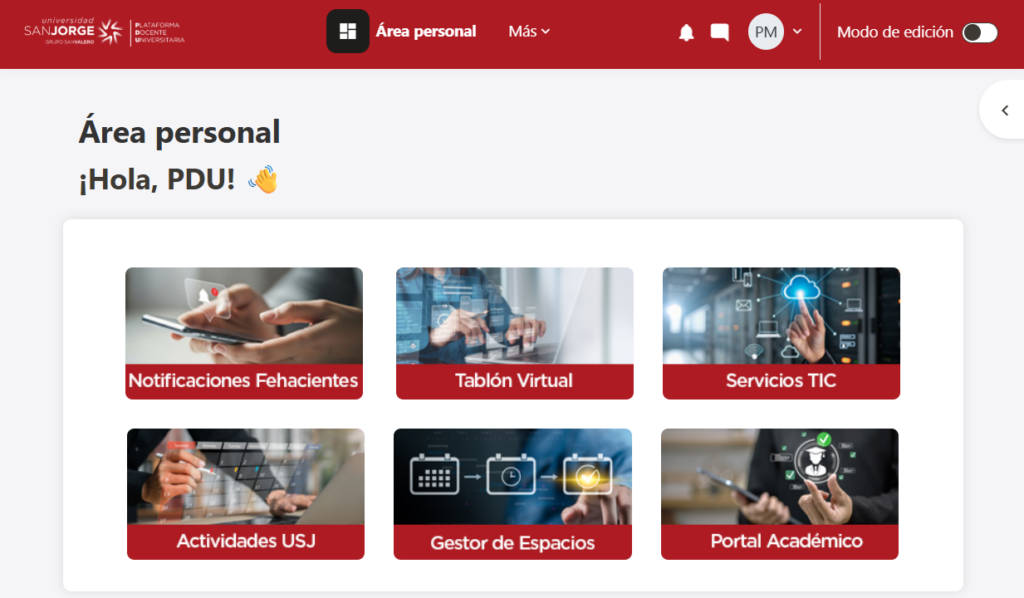
The solution: an integration developed in collaboration with 3ipunt
To tackle this project, San Jorge University turned to 3ipunt, a Moodle Premium Partner, which supported the institution throughout the entire process of developing its platform.
In addition to the migration and upgrade of the virtual campus, the project involved the development of a bespoke plugin that connects Moodle to the academic management system via web services.
Thanks to this integration, the following are now synchronised automatically:
- Users
- Courses
- Registrations
- Cohorts
- Subject groups
This automation significantly reduces the amount of manual work and ensures that academic information is always kept up to date.
A virtual campus designed to accommodate thousands of students
Over the years, the platform has supported the university’s growth.
As Daniel Jiménez explains, the most noticeable change has been the increase in the number of users, although the real success lies in all the work carried out to make that growth possible without compromising the stability of the campus.
‘The number of users has grown exponentially, and that is perhaps the most striking change, but we believe that what matters most is all the work we have done to make that increase possible.’
Today, the platform offers a robust, stable environment that is capable of handling the day-to-day activities of the entire university community.

The features that add the most value
Although Moodle includes numerous teaching tools, two aspects in particular stand out at San Jorge University.
On the one hand, integrations with other corporate applications, which have simplified the work of the technical team and the teaching staff.
On the other hand, the official Moodle app, which has brought the virtual campus into line with students’ digital habits, making it easier to access learning from any device.
Looking to the future: AI, accessibility and an increasingly connected approach to teaching
San Jorge University is already working towards an even smarter, more integrated and more accessible platform.
Key areas for future development include:
- To incorporate artificial intelligence-based tools to support teachers and pupils.
- To integrate new solutions for classroom interaction and content creation.
- Improve the platform’s digital accessibility.
- To establish Moodle as the central hub of the teaching experience.
For Daniel Jiménez, artificial intelligence will be one of the key drivers of transformation in higher education over the coming years, although he stresses that the real value will continue to lie in experiential learning, personalisation and student support.
A Moodle that evolves in step with the university
The case of San Jorge University shows that a virtual campus should not be limited to managing courses.
When Moodle is integrated with the organisation’s other systems and evolves in line with its needs, it becomes a strategic infrastructure capable of supporting institutional growth, facilitating the work of teaching staff and offering a better experience for students.
At 3ipunt, we continue to help universities and educational institutions get the most out of Moodle through bespoke developments, integrations and solutions that prepare their platforms for the challenges of the future.