
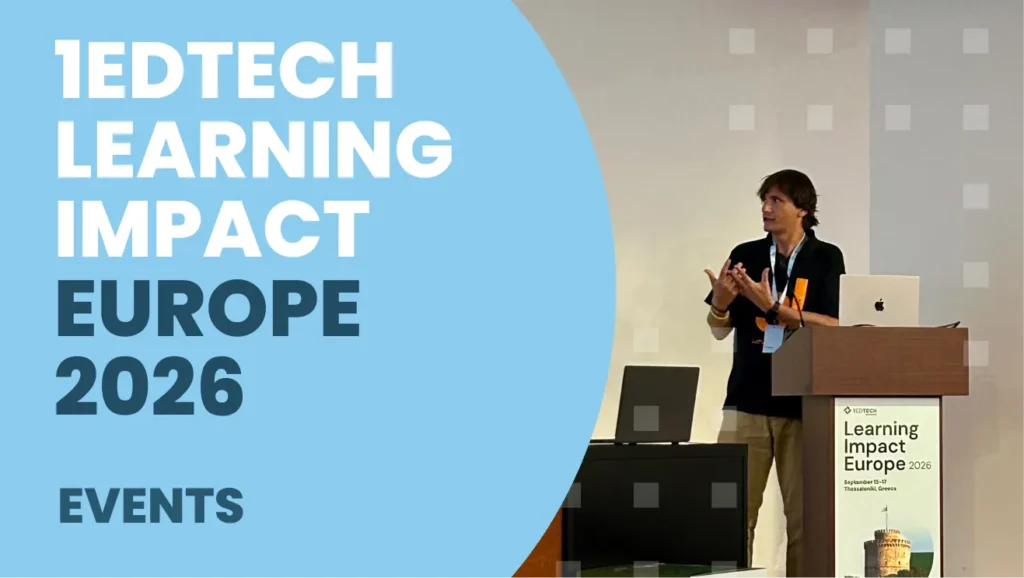
From 15 to 17 September, we were in Thessaloniki at Aristotle University, where the 1EdTech Learning Impact Europe 2026 event took place. Over the course of three days, universities, public authorities and technology providers from across Europe discussed how they are connecting their systems: enrolment, identities, credentials and tools that, until recently, operated in silos. We were there both as sponsors of the event and as speakers.

What is the current state of educational interoperability in Europe?
One idea ran through all three days: interoperability standards have moved beyond being mere specification documents to become actual implementations. The debate is no longer about whether they will work, but how they are rolled out in institutions with tens of thousands of students. If your organisation uses Moodle, much of what was presented has a direct impact on how your platform communicates with the rest of the campus systems.
1EdTech Europe is now a reality
We attended the first General Assembly of 1EdTech Europe, at which the articles of association and the board were approved. The European organisation is moving towards establishing its own structure within 1EdTech, with a very specific underlying objective: to ensure that all standards are compatible with European regulations and frameworks.
What is already underway:
- Mapping of Edu-API 1.0 and Open Badges 3.0 against the European Learning Model (ELM), with work in progress.
- Designated working groups that will publish the European profiles of the specifications.
- DESM (1ed.tech/desm) as the tool used to design these maps.
This is not a mere bureaucratic detail. It means that international specifications will have a version that fits within the European regulatory framework, and that reduces the adaptation work that each institution currently has to carry out on its own.
LTI: improving integrations
The LTI module has introduced new features that have a significant impact on how we integrate tools into the LMS:
- LTI Asset Processor. A new specification based on LTI 1.3, introduced by Turnitin, which opens up a range of new services and workflows for integrations.
- LTI Link and Content Service + Platform Notification Service. They solve a real problem: until now, once content had been uploaded to a course, the system would go silent. With these services, the tool can monitor and update the content that has been uploaded, and the platform can notify users of any changes. An end-to-end demonstration was shown featuring Blackboard, Cengage and Turnitin.
- The case of the United Kingdom. CoSector (University of London) explained how they are organising the assessment and feedback on LTI at institutional and national levels.
The practical benefit of the second point is obvious to anyone who manages a large catalogue: fewer broken links and less out-of-date content, without the need for manual checks course by course.
Edu-API
Edu-API is the standard that meets the university’s needs – a considerably more complex scenario than OneRoster, which is designed for K-12. It enables the synchronisation of enrolments, students and courses between the SIS and the LMS, which is one of the most frequently requested features in any university project.
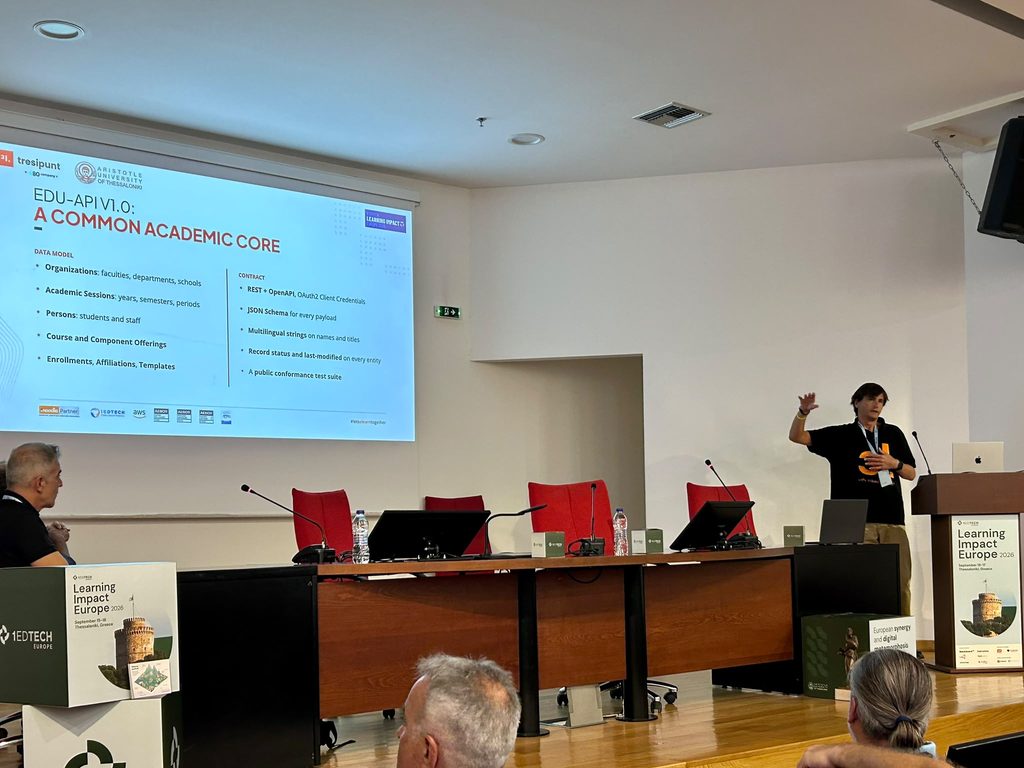
We are presenting “From Interoperability to Impact: Edu-API Implementation for Moodle” in collaboration with Aristotle University of Thessaloniki. We will discuss architectural decisions, challenges encountered during implementation, and the opportunities that Edu-API opens up for analytics and new services.
There was a high level of interest, and not just in our session. 1EdTech presented its update to the standard, featuring new endpoints and ELM profiling. GUnet explained how they have integrated Edu-API into Open eClass. And Aristotle University itself demonstrated its Universis Edu-API exporter, which synchronises the SIS in real time and includes its own consumer plugin for Moodle. Three different implementations at a single event send a clear signal: the standard is moving from specification to actual implementation.
Wallets and identities: from pilot to production
The credentials section has the longest way to go. There was discussion of verifiable credentials, Open Badges 3.0 and European Digital Credentials on ELM, with eIDAS 2 and the EUDI Wallet serving as the reference framework.
Two case studies went down well. SURF presented its transition from Edubadges to eduCredentials, alongside the eduwallet pilot. And GUnet explained the roll-out of the new student ID card at the University of Athens, serving over 90,000 students, combining the European Student Card, verifiable credentials and a digital wallet, using only data from the SIS.
The message from the group was straightforward: the project is moving from the pilot phase to production, whilst the debate continues as to whether the wallet ecosystem is now mature enough for universities.
European partnerships and data spaces
The final major topic was how institutions exchange data with one another.
The UOC presented its case as part of the European DS4Skills project, a federated data platform that cross-references the university’s own educational data with labour market data to guide students and tailor the range of courses on offer, always using the ELM format and in compliance with GDPR and privacy regulations.
The OpenEU alliance, for its part, showcased its Joint Learning Platform, which serves as a testbed for the pillars of the European Higher Education Interoperability Framework (HEIF). The challenge it aims to tackle is no small one: global authentication, enrolment, study programmes and qualifications across institutions with very different levels of maturity and cultures.

What does this mean if you manage a Moodle platform?
We go to these events with one question in mind: which of the things presented there are applicable to the projects we’re currently working on. Here’s what we took away from Thessaloniki:
- Edu-API is currently the most reliable way to connect the SIS with Moodle in university settings, and there are already working implementations that demonstrate this.
- LTI’s new features enable you to keep integrated content alive, rather than simply placing it there.
- Verifiable credentials and alignment with the European framework are no longer an experiment and are now requiring architectural decisions, particularly within public institutions.
Sponsoring the event and taking part in the working groups where standards are drawn up enables us to approach projects with the groundwork already done, rather than having to react when regulatory requirements become more stringent.